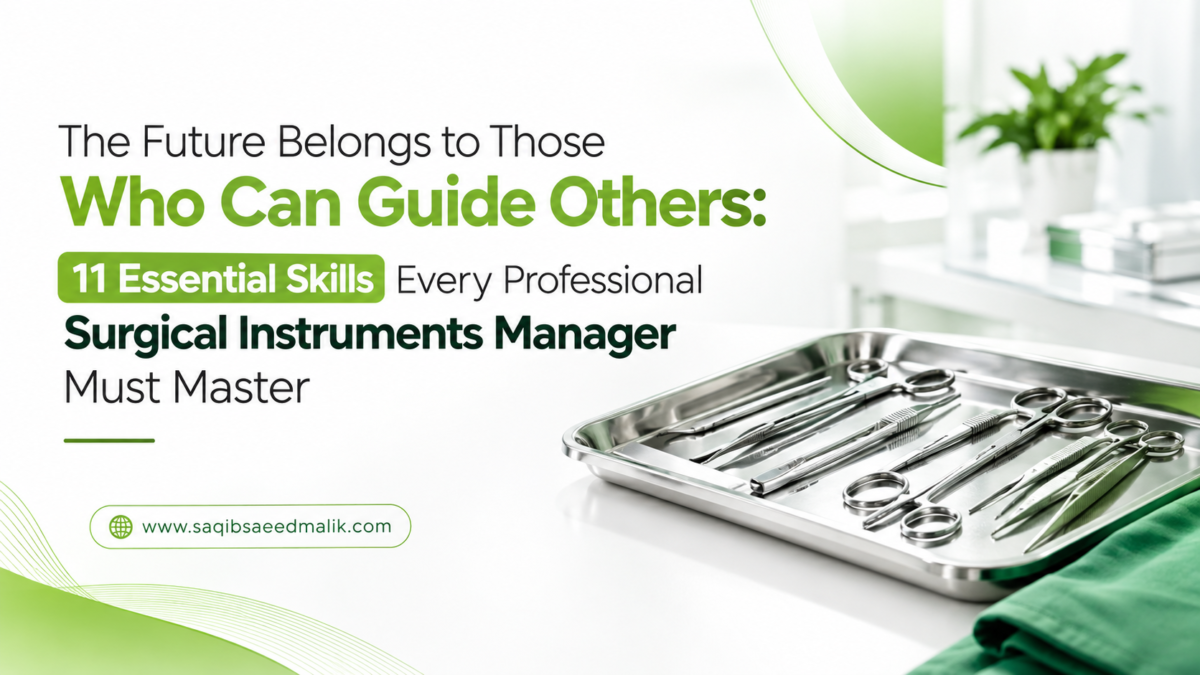
The Future Belongs to Those Who Can Guide Others: 11 Essential Skills Every Professional Surgical Instruments Manager Must Master

Introduction: Why Surgical Instruments Management Demands More Than Product Knowledge

Behind every reliable surgical instrument supply operation is a professional who understands that quality, precision, and responsibility cannot be compromised. A surgical instruments manager does far more than oversee inventory or process orders. This role connects healthcare professionals, procurement teams, manufacturers, suppliers, and business operations through decisions that can influence efficiency, product availability, and customer confidence. The medical instruments industry continues to demand professionals who can combine technical knowledge with commercial awareness and strong leadership. Hospitals and clinics expect reliable products, suppliers must maintain quality standards, and surgical professionals need instruments that meet the requirements of their procedures. A manager who understands these interconnected responsibilities becomes an essential part of the healthcare supply chain.

1. Master Surgical Instrument Knowledge Before You Lead Others

Leadership begins with understanding what you manage. A professional surgical instruments manager should understand instrument categories, functions, materials, construction, and intended applications. This includes familiarity with forceps, scissors, needle holders, retractors, clamps, suction instruments, dental instruments, and specialist surgical tools. Product knowledge also means recognizing differences between similar-looking instruments. For example, variations in jaw design, tip configuration, length, material, and working mechanism can determine whether an instrument is suitable for a particular clinical application. Managers should know how to consult product specifications, manufacturer instructions, and approved technical documentation instead of relying on assumptions. The more accurately you understand your products, the more confidently you can guide customers, train employees, and support informed purchasing decisions.

2. Develop Leadership Skills That Build Trust and Accountability

A manager’s real value becomes visible when a team faces pressure. An urgent order, a delayed shipment, a customer complaint, or an inventory discrepancy can quickly reveal whether a leader can organize people and make sound decisions. Professional leadership means providing clear direction, setting expectations, listening carefully, and taking responsibility when something goes wrong. In surgical instruments management, authority alone is not enough. Employees need to understand why accuracy matters, why product information must be verified, and why customer commitments should be realistic. Strong managers create a culture in which people communicate problems early instead of hiding mistakes. When team members know that standards are consistent and their contributions matter, accountability becomes part of daily work rather than a rule imposed from above.

3. Understand Inventory Control, Procurement, and Demand Planning

Inventory management is one of the most commercially important skills in the surgical instruments business. Too little stock can delay fulfillment and disappoint customers, while excessive inventory ties up working capital and increases storage, obsolescence, and forecasting risks. A capable manager must balance product availability with responsible purchasing decisions. Learn to monitor stock movement, supplier lead times, reorder points, demand patterns, purchase orders, and slow-moving products. Use reliable inventory systems to identify frequently requested instruments and anticipate seasonal or customer-specific demand where relevant. Maintain clear processes for receiving, inspecting, storing, and dispatching products. For reusable instruments, distinguish inventory management from clinical reprocessing responsibilities, which must follow applicable healthcare procedures and manufacturer instructions. Effective inventory control protects both business performance and customer confidence.

4. Make Quality Assurance and Regulatory Awareness Non-Negotiable

In healthcare, product quality is not simply a competitive advantage. It is a fundamental responsibility. Surgical instruments must meet applicable product requirements, and managers need to understand the quality documentation, traceability, handling procedures, and regulatory obligations relevant to the products and markets they serve. A professional should be able to review specifications, identify incomplete documentation, recognize damaged or nonconforming products, and escalate quality concerns through the appropriate channels. Depending on the instrument and jurisdiction, relevant considerations may include manufacturer instructions, applicable medical device regulations, quality management systems, and documented complaint-handling procedures. Managers should never make unsupported claims about certification, sterility, or clinical suitability. When a concern arises, documented verification and timely escalation are more valuable than a confident guess.

5. Become an Exceptional Communicator With Hospitals, Clinics, and Suppliers

Product expertise can open a conversation, but communication often determines whether a business relationship lasts. Surgical instruments managers regularly communicate with procurement officers, healthcare administrators, clinicians, distributors, manufacturers, warehouse employees, and sales teams. Each audience has different priorities, and a successful manager knows how to respond without confusing technical detail with unnecessary complexity. When speaking with a hospital procurement team, clarity about specifications, pricing, delivery schedules, documentation, and after-sales support is essential. When coordinating with a supplier, precise product references and realistic deadlines reduce misunderstandings. When handling a complaint, listening carefully and acknowledging the issue can help preserve trust while the facts are investigated. Professional communication is not about promising everything a customer wants to hear. It is about providing accurate information, setting clear expectations, and doing what you said you would do.

6. Strengthen Commercial Intelligence, Negotiation, and Profitability

A surgical instruments manager must understand the financial realities behind every order. Revenue matters, but revenue alone does not reveal whether a transaction is sustainable. Purchasing costs, freight, import duties where applicable, storage, returns, discounts, payment terms, and operating expenses can all affect profitability. Develop the ability to evaluate supplier quotations, compare product specifications, negotiate fair commercial terms, and identify opportunities to improve purchasing efficiency. Avoid selecting a supplier based exclusively on the lowest price when quality, documentation, consistency, or delivery reliability are uncertain. Likewise, avoid making sales promises that the business cannot fulfill. The strongest commercial decisions balance cost, quality, service, and long-term customer value. Managers who understand both the product and the numbers can contribute meaningfully to business growth.

7. Learn Digital Systems, Data Analysis, and Modern Supply Chain Technology

Modern surgical instruments management increasingly depends on accurate information. Spreadsheets, enterprise resource planning systems, customer relationship management platforms, inventory software, and purchasing dashboards can help managers make decisions faster and identify problems before they become expensive. Start by learning how to interpret inventory turnover, order fulfillment rates, supplier performance, customer retention, forecast accuracy, and product return trends. These measurements help reveal whether operations are improving or simply becoming busier. Digital systems can also support document control, traceability, reporting, and communication across departments. Artificial intelligence may assist with forecasting, routine analysis, and administrative work, but its outputs must be checked against reliable data and professional judgment. Technology should strengthen accountability, not replace it.

8. Build Problem-Solving Skills for High-Pressure Situations

Even well-managed businesses experience disruptions. A supplier may miss a delivery date, a product may arrive damaged, a customer may request an unavailable specification, or a quality complaint may require immediate investigation. The manager’s responsibility is to respond methodically instead of allowing urgency to produce avoidable mistakes. Begin by establishing the facts. Identify the affected product, order, customer, timeline, and potential consequences. Determine what can be resolved immediately and what requires escalation to quality, regulatory, logistics, or senior management personnel. Communicate realistic options, document decisions, and follow through until the matter is closed. Afterward, investigate the underlying cause and improve the process where necessary. A temporary solution may resolve today’s problem, but a properly conducted review can prevent the same problem from affecting tomorrow’s customers.

9. Train Employees and Turn Individual Knowledge Into Team Capability

A manager who keeps every important task dependent on personal knowledge creates a fragile operation. A professional who teaches others creates a stronger business. Training should cover product identification, order accuracy, customer communication, inventory procedures, documentation, quality escalation, and the boundaries of each employee’s responsibilities. Develop standard operating procedures, practical training sessions, product reference materials, and clear performance expectations. Encourage employees to ask questions when specifications are uncertain and to report errors before they affect customers. Assess training through demonstrated competence rather than attendance alone. Where duties involve regulated activities or specialized technical procedures, ensure that personnel receive appropriate training and authorization. Your long-term impact as a manager is not measured only by the orders you complete, but also by the quality of the decisions your team can make without constant supervision.

10. Protect Customer Relationships Through Ethical and Service-Oriented Management

Trust is one of the most valuable assets in the medical supplies industry, and it can take years to establish. Customers remember whether products arrived as promised, whether questions received accurate answers, and whether someone took responsibility when an issue occurred. They also notice when a supplier prioritizes a quick sale over their actual requirements. A responsible surgical instruments manager builds relationships through transparent product information, dependable service, appropriate follow-up, and honest commercial practices. Understand the customer’s needs before recommending a product, and never exaggerate clinical benefits or imply that an instrument is suitable for a procedure without adequate verification. Respect confidentiality, follow applicable procurement policies, and manage conflicts of interest appropriately. Long-term relationships are built when customers know they can depend on your judgment, even when the answer is not the easiest one to give.

11. Commit to Continuous Professional Development and Strategic Thinking

The most effective managers understand that professional growth does not end with a promotion. Product ranges change, supply chains evolve, digital systems improve, and regulatory requirements differ across markets. A manager who stops learning risks making decisions based on outdated knowledge while competitors develop better processes and stronger customer relationships. Build a development plan around technical product education, procurement, inventory planning, quality management, communication, financial literacy, and leadership. Seek guidance from experienced colleagues, learn from supplier training, attend relevant industry events, and study the requirements of the markets in which your organization operates. Where appropriate, pursue recognized training in supply chain management, quality management, or medical device regulation. Then translate what you learn into measurable improvements, such as fewer order errors, better stock availability, more reliable delivery performance, or stronger customer retention.

Conclusion: Your Future Depends on the Value You Bring to Others

Becoming a professional surgical instruments manager requires a combination of technical knowledge, leadership, operational discipline, commercial understanding, and ethical judgment. None of these capabilities works in isolation. Product expertise without communication creates confusion. Sales ability without quality awareness creates risk. Inventory control without financial understanding can waste resources. Leadership without accountability weakens the entire operation. The opportunity is to become the professional people trust when accuracy matters, decisions carry consequences, and several departments must work together. Start by identifying the skills you need to strengthen, choose practical learning goals, and apply them consistently in your daily responsibilities. Measure your progress through better processes, stronger relationships, and more reliable results. The future belongs to professionals who can guide others with knowledge, sound judgment, and integrity. In surgical instruments management, that means helping your team perform better, helping customers make informed decisions, and helping your organization deliver dependable service in an industry where quality matters every day.

Understanding Surgical Instruments: The Key to Effective Patient Care By Saqib Saeed Malik, Founder & CEO of Nazmed SMS Sdn Bhd

In the intricate world of healthcare, every detail matters—especially when it comes to the precision of surgical procedures. Surgeons rely not only on their expertise but also on the tools they wield. A well-crafted surgical instrument can be the difference between an efficient procedure and a challenging one, impacting both surgical outcomes and patient recovery. At Nazmed SMS Sdn Bhd, a pioneering medical equipment company in Malaysia, we believe that effective patient care starts with quality surgical instruments. With over two decades of industry experience, we are dedicated to manufacturing and exporting surgical, dental, medical, and orthopedic instruments that meet the highest standards of precision, functionality, and durability.

The Significance of Surgical Instruments in Patient Care

Surgical instruments are more than just tools; they’re an extension of the surgeon’s hands. Each instrument, from forceps to retractors, plays a specific role, crafted to meet the exact demands of modern surgical procedures. For healthcare providers, understanding each tool’s purpose and mechanics is crucial. This knowledge empowers them to choose the right instrument for the job, reducing potential errors and maximizing surgical efficiency. The result? Enhanced patient safety, reduced surgical complications, and faster recovery times.

At Nazmed SMS Sdn Bhd, we understand that a thorough knowledge of surgical instruments is essential for improving patient outcomes. A small deviation in an instrument’s design, like the curve of a scissor blade or the texture of a forceps grip, can make a notable difference in a surgeon’s ability to perform delicate procedures with accuracy. Our portfolio includes a wide array of high-quality instruments like scissors, needle holders, and clamps, each tailored to meet specific surgical needs.

Key Surgical Instruments and Their Roles in Procedures

While surgical procedures vary significantly, certain instruments remain fundamental across a broad spectrum of surgeries. Here’s a closer look at some essential tools and how they contribute to effective patient care:

  1. Scissors
    Surgical scissors are designed to cut tissues with precision, helping surgeons avoid damage to surrounding areas. At Nazmed SMS, we offer scissors with both straight and curved blades, each crafted to provide stability and ease of control. Specialized scissors are tailored for different tissues and stages in a surgery, allowing for meticulous dissection and reducing the risk of excessive bleeding.
  2. Forceps
    Often used to grasp or hold tissue, forceps come in various types depending on the surgical need. Adson forceps, for instance, are favored for their precision in handling small tissues, while tissue forceps provide a strong grip necessary for holding dense tissue during major surgeries. Understanding the differences in forceps design allows healthcare professionals to apply the appropriate amount of pressure, avoiding unnecessary tissue damage.
  3. Needle Holders
    A vital tool for suturing, needle holders must offer a comfortable grip and firm control. At Nazmed SMS, we design our needle holders to have smooth surfaces that reduce hand fatigue and enhance suture precision. The alignment of the jaws and the locking mechanism is meticulously calibrated, helping surgeons achieve clean and reliable sutures every time.
  4. Retractors
    Retractors are used to hold back tissue, providing surgeons with clear visibility and access to the surgical site. They come in various shapes and sizes to cater to different procedures, and the correct retractor choice can significantly impact the duration and ease of a procedure. We offer retractors that are ergonomically designed, allowing for minimal strain on the patient’s body and efficient maneuvering by the surgical team.
  5. Clamps
    In surgeries, controlling blood flow is essential. Surgical clamps allow surgeons to temporarily restrict blood flow to specific areas, preventing excessive bleeding and maintaining a clear surgical field. Nazmed SMS offers clamps in various designs to ensure compatibility with different vessels and tissues, and our clamps are designed to release smoothly, minimizing trauma upon removal.

The Importance of Quality in Surgical Instruments

High-quality surgical instruments can vastly improve the efficacy and safety of surgical procedures. For a surgeon, reliability and predictability in their instruments are non-negotiable. At Nazmed SMS, we meticulously inspect and test each product to ensure it meets stringent standards. Our instruments are made from medical-grade stainless steel, known for its resistance to corrosion and durability, which allows for repeated sterilization without compromising performance. This commitment to quality not only enhances the lifespan of our instruments but also contributes to patient safety by reducing the risk of instrument failure during surgery.

Training and Education: Equipping Healthcare Professionals

In the fast-paced environment of a surgical theater, even a brief hesitation can lead to complications. Thus, it is imperative for healthcare providers to be well-versed with the instruments they use. Training programs that focus on surgical instrument familiarity are invaluable. At Nazmed SMS, we not only manufacture instruments but also advocate for ongoing education in their use. We work closely with medical professionals, providing resources and training to ensure they are equipped to select and utilize our instruments effectively. This education can lead to increased surgical efficiency and, ultimately, better patient outcomes.

Investing in the Right Tools for Optimal Patient Care

Choosing the right surgical instruments is an investment in quality patient care. A well-equipped surgical team is empowered to perform with accuracy and confidence, reducing the likelihood of complications. At Nazmed SMS Sdn Bhd, we are committed to supporting healthcare facilities by supplying them with state-of-the-art instruments that make a meaningful impact in the operating room. We understand that every instrument in our portfolio, whether it’s a basic tool or a specialized device, has a direct role in patient care and recovery.

Nazmed SMS’s Vision for the Future of Surgical Care

As we look ahead, Nazmed SMS is focused on innovating further and continuing to meet the evolving needs of healthcare professionals. With advancements in technology, we are exploring new materials and designs that enhance functionality, durability, and ease of use. We are also committed to sustainable practices, ensuring that our manufacturing processes minimize environmental impact without compromising on quality. Our mission is to be at the forefront of surgical instrument manufacturing, setting standards in quality, precision, and patient-centered care.

Conclusion: Bridging Precision and Patient Care

In the realm of healthcare, the smallest details can have profound impacts. Surgical instruments, though often understated, play a critical role in patient outcomes. At Nazmed SMS Sdn Bhd, we take pride in contributing to the field of medical care by offering instruments that meet the highest standards of quality and reliability. For healthcare professionals, understanding and selecting the right surgical instruments can bridge the gap between effective procedures and optimal patient care. Our commitment at Nazmed SMS is not only to the craftsmanship of our instruments but also to the wellbeing of the patients whose lives depend on them.

Effective patient care begins with precision, and at Nazmed SMS, we are dedicated to providing that precision every step of the way.

Top 5 Medical Surgical Supplies in Malaysia: A Guide by Mr. Saqib Saeed Malik, Founder of Nazmed SMS Sdn Bhd

As the founder of Nazmed SMS Sdn Bhd, a leading medical instrument supplier in Malaysia, I am privileged to witness the evolution of the healthcare industry firsthand. In Malaysia, where quality healthcare is of utmost importance, the availability of top-notch medical surgical supplies is critical for ensuring the well-being of patients and the success of healthcare providers. Here, I present a curated list of the top 5 medical surgical supplies that are indispensable in the Malaysian healthcare landscape:

  1. Surgical Instruments:

Surgical instruments form the backbone of any medical facility, and their quality directly impacts patient outcomes. From scalpels and forceps to retractors and scissors, a comprehensive set of surgical instruments is essential for performing a wide range of surgical procedures with precision and efficacy. At Nazmed SMS Sdn Bhd, we take pride in offering a diverse array of surgical instruments crafted with the highest standards of quality and reliability.

  1. Hospital Furniture:

Hospital furniture plays a crucial role in providing comfort and support to patients during their stay in medical facilities. From patient beds and examination tables to medical carts and chairs, well-designed hospital furniture enhances patient experience and facilitates efficient healthcare delivery. At Nazmed SMS Sdn Bhd, we offer a wide range of hospital furniture solutions that prioritize patient comfort, safety, and functionality.

  1. Diagnostic Equipment:

Diagnostic equipment is essential for accurately diagnosing medical conditions and guiding treatment decisions. In Malaysia, access to advanced diagnostic technologies such as X-ray machines, CT scanners, and ultrasound machines is crucial for delivering timely and accurate healthcare services. At Nazmed SMS Sdn Bhd, we partner with leading manufacturers to provide state-of-the-art diagnostic equipment that meets the highest standards of performance and reliability.

  1. Sterilization Equipment:

Sterilization equipment is essential for maintaining a clean and hygienic healthcare environment and preventing the spread of infections. Autoclaves, sterilizers, and disinfection systems are vital tools for sterilizing medical instruments and equipment before use in patient care. At Nazmed SMS Sdn Bhd, we offer a comprehensive range of sterilization equipment that ensures the safety and well-being of patients and healthcare providers alike.

  1. Anesthesia Machines:

Anesthesia machines are critical for administering anesthesia to patients undergoing surgical procedures or medical treatments. These machines deliver precise doses of anesthesia gases and monitor the patient’s vital signs during anesthesia administration, ensuring safe and effective anesthesia management. At Nazmed SMS Sdn Bhd, we provide high-quality anesthesia machines that prioritize patient safety and comfort, enabling healthcare providers to deliver optimal anesthesia care.

In conclusion, the availability of top-quality medical surgical supplies is essential for ensuring the delivery of high-quality healthcare services in Malaysia. From surgical instruments and hospital furniture to diagnostic equipment, sterilization equipment, and anesthesia machines, these supplies form the foundation of a robust healthcare system. At Nazmed SMS Sdn Bhd, we are committed to providing healthcare facilities in Malaysia with the highest quality medical surgical supplies that meet their diverse needs and support their mission of delivering exceptional patient care.

Every Connection Counts: Saqib Saeed Malik’s Vision for Networking Excellence at NAZMED SMS SDN BHD

In the bustling landscape of global commerce, every connection is a potential catalyst for growth, innovation, and excellence. This sentiment is not lost on Saqib Saeed Malik, the visionary founder, and CEO of NAZMED SMS SDN BHD, a young and dynamic company based in Malaysia. Specializing in the manufacturing and export of surgical, dental, medical, and orthopedic instruments, NAZMED SMS SDN BHD is not merely a provider of healthcare solutions; it is a testament to the power of meaningful connections. In this article, we delve into Saqib Saeed Malik’s perspective on the importance of networking and the company’s journey towards excellence.


Networking as a Strategic Imperative

For Saqib Saeed Malik, networking is not just a side activity; it is a strategic imperative that shapes the trajectory of NAZMED SMS SDN BHD. Every event, exhibition, training session, or networking opportunity is viewed as a chance to forge connections that go beyond the exchange of business cards. Mr. Malik believes that every single connection matters, laying the foundation for collaborative endeavors, partnerships, and shared success.


“At NAZMED, we understand the significance of relationships in the business world. Networking is not just about expanding our reach; it’s about building a community of like-minded individuals and organizations that share our commitment to excellence in healthcare solutions,” states Saqib Saeed Malik.


Connecting Bits: A Holistic Approach to Networking

Mr. Malik emphasizes the holistic nature of networking at NAZMED. It’s not just about collecting contacts; it’s about connecting bits of knowledge, experience, and expertise to create a tapestry of innovation and growth. Whether attending industry events, exhibitions, or specialized training sessions, the focus is on absorbing insights, sharing knowledge, and building bridges that transcend the boundaries of business transactions.


“Every conversation, every shared idea is a piece of the puzzle. By connecting these bits, we enrich our understanding of the industry, stay abreast of the latest advancements, and cultivate a culture of continuous learning within our organization,” adds Mr. Malik.


Training: A Nexus for Knowledge Exchange

In the pursuit of excellence, NAZMED SMS SDN BHD places significant importance on training as a nexus for knowledge exchange. Training sessions not only empower the company’s workforce but also serve as forums for networking with industry experts, professionals, and potential collaborators. Mr. Malik envisions training not just as a means of skill development but as an avenue for building relationships that transcend the traditional boundaries of business.


“At NAZMED, we believe that training is not an isolated activity. It’s a platform for professionals to converge, share insights, and collectively contribute to the advancement of the healthcare industry. The connections forged during training sessions often become the seeds for future collaborations,” affirms Mr. Malik.


Journey to Excellence: A Collaborative Endeavor

The vision for networking at NAZMED SMS SDN BHD is deeply intertwined with the company’s overarching journey towards excellence. For Mr. Malik, excellence is not a solitary pursuit but a collaborative endeavor that involves pooling together the collective wisdom, skills, and aspirations of individuals and organizations within the industry.


“Our journey to excellence is not one we embark on alone. It’s a shared voyage with our partners, clients, and the broader healthcare community. By fostering strong connections, we amplify our impact and contribute to the elevation of healthcare standards globally,” elucidates Mr. Malik.


Conclusion: NAZMED SMS SDN BHD – Where Connections Ignite Excellence

In conclusion, Saqib Saeed Malik’s vision for networking at NAZMED SMS SDN BHD transcends the conventional notions of business interactions. It is a philosophy that views every connection as a building block, every shared idea as a catalyst for innovation, and every training session as a nexus for collaborative growth. The journey to excellence at NAZMED is not a solo expedition; it’s a collective odyssey where connections ignite the flames of progress in the healthcare solutions landscape.


As NAZMED SMS SDN BHD continues to weave its story of success and impact, the emphasis on meaningful connections remains at the forefront. In the dynamic world of healthcare solutions, where advancements are driven by collaboration and shared insights, NAZMED stands as a beacon of excellence where every connection counts, and the journey towards a healthier and more innovative future is a collective endeavor.