
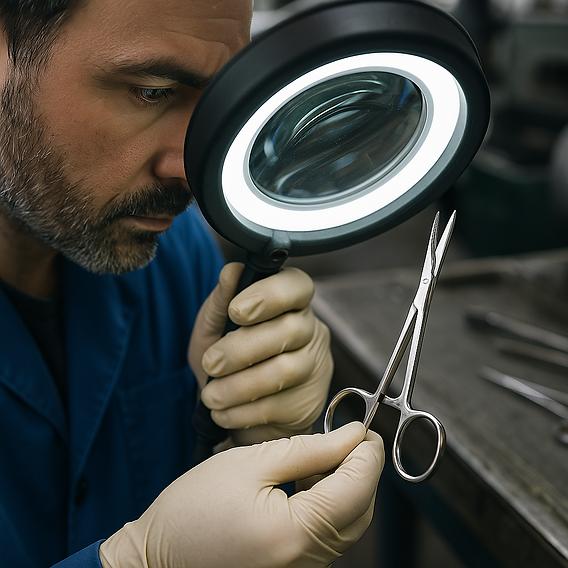
Introduction: Instrument quality is a matter of trust, not appearance
In healthcare, even the smallest instrument can make a significant difference. A surgeon depends on the accuracy of scissors, the grip of forceps, the alignment of needle holders, and the consistency of every instrument used during a procedure. These details are not minor manufacturing considerations. They directly influence how confidently medical professionals can perform their work. A surgical instrument may appear polished, well-finished, and professionally packaged, but appearance alone cannot establish its quality. Its real value becomes evident through precision, material integrity, functionality, resistance to corrosion, ease of cleaning, and consistent performance throughout its intended service life. This is why instrument quality standards deserve serious attention from hospitals, surgical centres, medical distributors, procurement departments, and healthcare professionals. Choosing instruments without examining their quality can create unnecessary operational difficulties, increase replacement costs, and introduce avoidable risks into clinical environments. The healthcare industry requires more than products that simply look professional. It requires instruments manufactured, tested, inspected, and maintained according to appropriate quality and safety requirements.
What are instrument quality standards?
Instrument quality standards are established requirements and technical criteria used to evaluate the safety, performance, reliability, manufacturing consistency, and suitability of medical instruments for their intended applications. These standards help establish whether an instrument has been designed and manufactured appropriately, whether its materials meet relevant specifications, and whether it can perform its intended function consistently. In surgical environments, quality considerations extend across several areas, including material selection, dimensional accuracy, surface finishing, mechanical performance, corrosion resistance, cleanliness, packaging, and traceability. A reliable instrument must meet the requirements applicable to its specific category and intended use. A surgical scissors manufacturer, for example, must consider cutting performance, blade alignment, joint movement, and edge durability. A needle holder requires dependable jaw alignment, secure needle retention, and an appropriate locking mechanism. Different instruments have different technical requirements. Applying a single general quality checklist to every instrument is therefore insufficient. The objective is straightforward: every instrument should be suitable for its intended clinical purpose and supported by appropriate quality controls.
Why instrument quality matters in modern healthcare
The quality of medical instruments affects more than the immediate surgical procedure. It influences workflow efficiency, professional confidence, equipment management, and the overall reliability of healthcare operations. Consider a surgical team working under time-sensitive conditions. Every instrument must function as expected. A poorly aligned forceps, blunt scissors, or unreliable locking mechanism can interrupt workflow and require instrument replacement. These situations demonstrate why instrument quality should never be treated as an afterthought.
Patient safety and clinical reliability Medical instruments must be appropriate for their intended use and must not introduce avoidable hazards through poor construction, unsuitable materials, or defective components. Reliable manufacturing and inspection processes help reduce the likelihood of problems such as mechanical failure, corrosion, surface defects, and inconsistent functionality. Surgical precision and performance Precision is central to surgical instrument design. Instruments must provide the control, movement, grip, and functionality expected by medical professionals. Small manufacturing differences can influence performance. This makes dimensional accuracy, component alignment, and functional testing essential quality considerations. Long-term cost efficiency Purchasing decisions based only on initial price can create higher expenses over time. Instruments that deteriorate quickly, lose their functionality, or require frequent replacement may increase the overall cost of ownership. Quality procurement considers durability, maintenance requirements, repairability, expected service life, and the availability of reliable replacement options. Professional confidence Healthcare professionals depend on equipment that behaves consistently. Reliable instruments help create a more predictable working environment and support confidence in clinical processes.
1. Material selection: The foundation of instrument quality
Material selection is one of the most important factors in surgical instrument manufacturing. The material must support the instrument’s intended mechanical function while offering appropriate resistance to corrosion, repeated cleaning, and sterilization processes. Stainless steel is widely used in surgical instruments because different grades offer combinations of strength, corrosion resistance, hardness, and manufacturability.
However, not all stainless steel is identical.
2. Manufacturing precision and dimensional accuracy
Precision manufacturing separates dependable surgical instruments from products that merely resemble professional medical equipment.
Each instrument must be manufactured according to its design specifications. Dimensions, component alignment, tolerances, joint construction, and finishing all contribute to its performance.
For example, surgical scissors require properly aligned blades and suitable cutting geometry. Forceps require appropriate tip alignment and gripping characteristics. Needle holders need reliable jaw contact and locking performance. Manufacturing inconsistencies can affect these functions. Modern quality-focused production should incorporate controlled manufacturing procedures, appropriate equipment calibration, dimensional inspection, and documented acceptance criteria. The objective is not simply to produce an instrument that looks identical to a sample. It is to achieve consistent functional performance across production batches.
3. Surface finishing and corrosion resistance
Surface finishing plays an important role in instrument quality. A properly manufactured surface should be appropriate for the instrument’s design, intended use, and reprocessing requirements. Surface defects, rough areas, crevices, and damaged coatings can complicate cleaning and may contribute to corrosion or deterioration. Corrosion resistance is particularly important because surgical instruments are exposed to repeated cleaning, disinfecting, and sterilization processes. Even high-quality stainless steel can develop corrosion when exposed to unsuitable chemicals, prolonged moisture, contaminated cleaning solutions, or incorrect handling procedures. An instrument should never be judged solely by its appearance or manufacturing specifications. Its functional performance must also be evaluated. Functional testing verifies whether an instrument performs the task for which it was designed.
4. International standards and regulatory compliance
International standards provide important frameworks for manufacturers, suppliers, and healthcare organisations. They establish recognised approaches to quality management, risk control, medical device safety, and manufacturing consistency. However, it is important to understand that different standards address different aspects of quality. Certification to one standard does not automatically demonstrate compliance with every regulatory requirement or guarantee that every product is suitable for every clinical application. Some important frameworks include: ISO 13485 – Medical device quality management systems ISO 13485 establishes quality management system requirements for organisations involved in medical device design, development, production, storage, distribution, installation, and servicing, where applicable. It focuses on maintaining controlled processes, documented procedures, risk-based controls, traceability, and continual compliance with applicable requirements.
5. Cleaning, sterilization, and reusability
For reusable surgical instruments, quality does not end when the product leaves the factory. Instruments must be capable of undergoing the cleaning, disinfection, inspection, packaging, and sterilization processes specified for their intended use. Poor reprocessing can compromise even a well-manufactured instrument. Blood, tissue residues, cleaning chemicals, and moisture can contribute to contamination, staining, or corrosion when appropriate procedures are not followed.
6. Quality assurance and inspection throughout production
Quality assurance should not be restricted to the final stage of manufacturing. A dependable quality system incorporates controls throughout the production process, beginning with material sourcing and continuing through manufacturing, finishing, inspection, packaging, and distribution. This approach helps identify problems earlier and reduces the likelihood of defective products reaching customers. A structured quality assurance process generally includes incoming material verification, production monitoring, in-process inspection, final functional testing, documentation, and batch identification. Traceability is particularly important. Manufacturers should maintain appropriate records that help identify materials, production batches, inspection results, and relevant corrective actions. When a quality concern arises, traceability allows organisations to investigate the affected products more effectively and determine the appropriate response. For medical suppliers, this information also supports responsible procurement and customer confidence.