
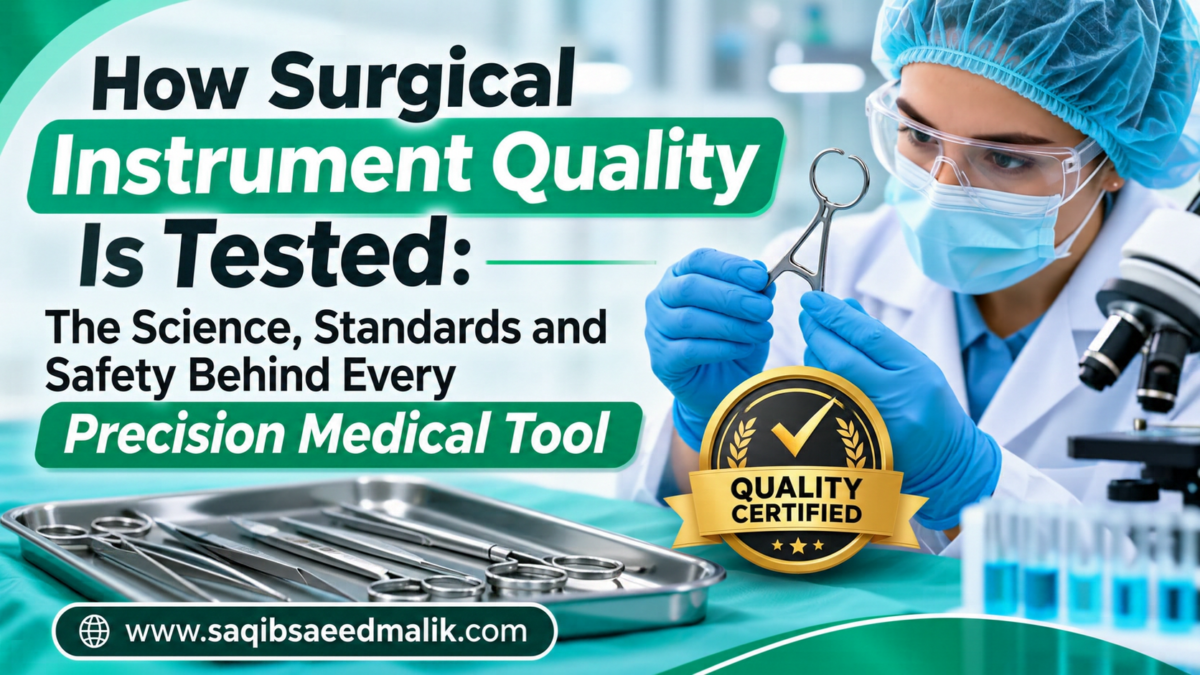
A surgical instrument is only as reliable as the testing behind it. In an operating room, even a minor defect can have serious consequences. A scalpel must maintain its cutting precision, scissors must deliver consistent performance, forceps must provide a secure grip, and needle holders must withstand repeated use without losing their function. These are not qualities manufacturers should simply promise. They must be demonstrated through rigorous inspection, material verification, functional testing, and quality assurance. Surgical instrument quality testing is much more than checking whether an instrument looks polished or feels comfortable in the hand. It is a systematic process designed to determine whether each instrument meets defined requirements for safety, durability, precision, functionality, and resistance to repeated sterilization. From selecting stainless steel to the final inspection before distribution, every stage contributes to the reliability of the finished product.
Why Surgical Instrument Quality Testing Matters
Surgical instruments operate in environments where accuracy and reliability are essential. Surgeons depend on them to perform delicate procedures, control bleeding, manipulate tissue, and complete complex operations. An instrument that fails to perform correctly can interrupt a procedure, increase operational risks, and create unnecessary complications. Consider a pair of surgical scissors used during a delicate procedure. If the blades are poorly aligned, the cutting action may become inconsistent. If the hinge is too tight, the surgeon may experience difficulty controlling movement. If the instrument contains surface defects or corrosion, its long-term suitability becomes questionable. These problems demonstrate why visual appearance alone cannot establish instrument quality. A product may look flawless but still have weak joints, poor mechanical performance, or inadequate resistance to corrosion. Quality testing helps manufacturers identify these issues before instruments reach healthcare professionals. It also gives hospitals and distributors greater confidence that the products they purchase have undergone appropriate manufacturing controls and verification.
1. Raw Material Testing: Quality Begins Before Manufacturing
The quality of a surgical instrument begins with its raw materials. Even the most advanced manufacturing process cannot consistently produce a reliable instrument from unsuitable material. Surgical instruments are commonly manufactured using medical-grade stainless steel, with different grades selected according to the instrument’s intended function, mechanical requirements, and exposure conditions. Some specialized instruments may use titanium or other suitable materials. Material testing helps confirm that the selected metal meets the required specifications. One important assessment is chemical composition testing. Manufacturers verify the presence and proportion of elements such as chromium, nickel, molybdenum, and carbon, depending on the specified steel grade. These elements influence properties such as corrosion resistance, hardness, and mechanical performance. Another important assessment involves mechanical properties. The material may be evaluated for hardness, strength, and other characteristics required for its intended application.
2. Visual Inspection: Identifying Defects Before They Become Problems
Visual inspection is one of the fundamental stages of surgical instrument quality control. During this process, trained quality inspectors examine instruments under suitable lighting and, where necessary, magnification. The objective is to identify visible defects that could affect performance, cleanliness, durability, or safety. Inspectors typically examine the instrument for:
- Surface scratches, cracks, and irregularities.
- Burrs, unwanted sharp edges, and manufacturing marks.
- Rust, staining, or signs of corrosion.
- Uneven polishing or finishing.
- Poor alignment of blades, jaws, or working ends.
- Loose components and inconsistent assembly.
- Defects around joints, hinges, and locking mechanisms.
3. Hardness Testing: Measuring Resistance to Wear and Deformation
Hardness is an important material property in surgical instrument manufacturing. It describes a material’s resistance to localized deformation, such as indentation. The required hardness depends on the instrument’s design and intended function. For instance, cutting instruments require suitable hardness to maintain their cutting edges. Instruments designed for gripping or clamping may require a different balance of hardness, strength, and toughness. One commonly used method is the Rockwell hardness test. In this process, a controlled force is applied through an indenter, and the resulting indentation is measured to determine the material’s hardness. Other methods, such as Vickers or Brinell testing, may also be appropriate depending on the material, component size, and applicable specification. Why does this matter? If a cutting instrument is too soft, its edge may wear or deform more quickly. If a component is excessively hard without adequate toughness, it may become more susceptible to cracking or damage under certain conditions.
4. Functional Testing: Does the Instrument Perform as Intended?
An instrument can pass a visual inspection and still fail to perform properly. This is why functional testing is one of the most important parts of surgical instrument quality evaluation. During functional testing, the instrument is assessed according to its intended purpose and design requirements. Different instruments require different tests.
- Surgical scissors: Inspectors assess blade alignment, cutting action, smooth movement, and cutting consistency across the intended working length.
- Forceps: Testing evaluates tip alignment, gripping performance, jaw contact, and the consistency of the gripping action.
- Needle holders: Inspectors examine jaw alignment, needle retention, ratchet engagement, and locking performance.
- Hemostatic forceps: Testing may include assessment of jaw alignment, locking mechanisms, and the consistency of the clamping action.
- Retractors: Their structural integrity, working-end design, and resistance to deformation are evaluated against relevant specifications.
Functional testing must be appropriate to the instrument. A cutting test designed for scissors cannot establish the quality of a retractor or needle holder. The purpose is straightforward: every instrument must demonstrate that it can perform its intended function consistently within defined acceptance criteria.
5. Corrosion Resistance Testing: Protecting Instruments Against Deterioration
Surgical instruments are repeatedly exposed to moisture, cleaning chemicals, disinfectants, and sterilization processes. These conditions make corrosion resistance an important quality consideration. Stainless steel is widely used because it forms a protective passive oxide layer that helps resist corrosion. However, stainless steel is not completely immune to corrosion. Poor manufacturing practices, surface contamination, unsuitable cleaning procedures, and improper handling can compromise its protective properties. Corrosion resistance testing evaluates how materials and finished surfaces respond to specified environmental conditions. Depending on the material and applicable standards, manufacturers may use standardized corrosion tests, including salt spray or other suitable exposure methods. Tests may also assess resistance to pitting or localized corrosion. Surface finishing plays an important role in this process. A properly manufactured and finished instrument should have surfaces appropriate for cleaning and its intended clinical use.
6. Surface Finishing and Polishing: More Than an Aesthetic Requirement
A professional surgical instrument should have a suitable surface finish. However, polishing is not simply about making the instrument look attractive. Surface quality contributes to cleaning effectiveness, corrosion resistance, and the overall condition of the instrument. Manufacturers inspect finished surfaces for scratches, pits, burrs, rough areas, and other irregularities that may compromise product quality. Different instruments may require different finishes depending on their design and intended application. A mirror finish, satin finish, or other specified surface treatment may be selected according to the product requirements. The quality control process should also consider areas that are difficult to inspect, including joints, serrations, hinges, and working ends. A poorly finished instrument may deteriorate faster or become more difficult to maintain. Proper finishing, combined with appropriate cleaning and maintenance procedures, helps support long-term instrument performance.
7. Joint, Hinge, and Locking Mechanism Testing
Many surgical instruments contain moving components. Their reliability depends on the accuracy of their assembly and the quality of their mechanical connections. Hinges, box locks, ratchets, and other mechanisms must operate consistently. Testing may involve checking:
- Smooth opening and closing movement.
- Correct alignment of connected components.
- Secure engagement of locking mechanisms.
- Appropriate operating resistance.
- Stability during repeated movement.
- Signs of looseness, excessive friction, or mechanical damage.
For example, a hemostatic forceps must close correctly and engage its ratchet securely. If the locking mechanism slips or fails to engage, the instrument may not perform as intended. Similarly, a surgical needle holder must maintain reliable jaw contact and locking performance. Some mechanical assessments may involve repeated operating cycles to evaluate durability. The number of cycles, test conditions, and acceptance criteria should be established according to the instrument’s design and applicable requirements.
8. Dimensional Accuracy Testing: Precision in Every Measurement
Surgical instruments are manufactured according to defined dimensions and design specifications. Even small dimensional variations can influence how an instrument performs, particularly when precision is essential. Dimensional testing verifies measurements such as:
- Overall instrument length.
- Blade length and thickness.
- Jaw dimensions.
- Tip geometry.
- Working-end alignment.
- Handle dimensions.
- Component tolerances.
Manufacturers may use calibrated measuring instruments, precision gauges, optical measurement systems, and other suitable equipment. For example, the tips of fine surgical forceps must be manufactured within the required dimensional and alignment tolerances. Variations could affect gripping performance and handling. Dimensional inspection is also important for ensuring consistency between production batches.
9. Cleaning and Sterilization Validation: Is the Instrument Suitable for Repeated Processing?
Surgical instruments must be capable of undergoing appropriate cleaning and sterilization processes according to their intended use and manufacturer instructions. However, it is important to distinguish between testing an instrument’s material durability and validating the complete reprocessing process. Manufacturers assess whether the instrument’s design, materials, and construction are suitable for the specified cleaning, disinfection, and sterilization conditions. Relevant assessments may include:
- Resistance to repeated exposure to specified cleaning agents.
- Compatibility with applicable sterilization methods.
- Resistance to corrosion following reprocessing.
- Functional performance after repeated processing.
- Evaluation of joints and difficult-to-clean areas.
- Assessment of material and surface changes.
Reusable instruments require particular attention because repeated processing can affect their condition over time. Cleaning validation is also important. Instrument designs should allow effective cleaning, including access to areas where organic material or other contamination could accumulate. Sterilization validation, meanwhile, concerns whether a defined sterilization process consistently achieves its required outcome under specified conditions.
10. Packaging and Final Inspection: The Last Quality Checkpoint
Even a properly manufactured instrument can be compromised if its packaging is unsuitable or its condition is affected before delivery. Final inspection verifies that the finished product meets the relevant requirements before it is released. This stage may include checking:
- Instrument identity and specifications.
- Final appearance and surface condition.
- Functional performance.
- Packaging integrity.
- Product identification and batch information.
- Instructions and relevant documentation.
- Traceability and release records.
Packaging requirements depend on whether the instrument is supplied sterile or non-sterile. Sterile medical devices require an appropriate validated sterile barrier system and packaging process. Non-sterile reusable instruments must be clearly identified and supplied with appropriate instructions for cleaning, disinfection, and sterilization before use. The final inspection process helps ensure that products are correctly identified, protected, and documented.
Conclusion: Surgical Instrument Quality Is Proven, Not Promised
A surgical instrument should never be judged by its appearance alone. Its quality is established through a combination of material verification, dimensional inspection, hardness assessment, functional testing, corrosion resistance evaluation, mechanical checks, processing compatibility, and documented quality assurance. Every test serves a purpose. Together, they help manufacturers demonstrate that their instruments are designed and produced to meet the requirements of their intended applications. For surgeons, dependable instruments support precision and confidence. For hospitals, they contribute to responsible procurement and equipment management. For medical suppliers, they help establish credibility and lasting customer relationships. The most important lesson is simple: quality in surgical instruments is not a marketing claim. It is a measurable responsibility supported by testing, standards, documentation, and consistent manufacturing practices. At NAZMED SMS SDN BHD, the importance of surgical and medical instrument quality remains central to the wider conversation about dependable healthcare supplies. As the medical industry continues to advance, informed purchasing decisions and a commitment to quality will remain essential for healthcare professionals and suppliers alike.